
Arcana 4:
A Chapter From The New Edison, Kerri-Anne Powell's 2028 Book on Jerome Eckerberg
CHAPTER 4: THE BARON AND THE HIPPIE
Charting a simple course through the murky waters of Jerome Eckerberg can be a daunting prospect. Most commentators lean into historical comparisons when trying to find the quick summary of the impossibly complex subject, and those who go in this direction most often return to the same point of comparison as I did with this book’s title: Thomas Edison. It is, in many ways, the most intuitive figure to stack up next to Eckerberg; two men who changed America’s relationship to power and electricity, each building an empire on top of the dead bodies of all of their competitors, with the iron fist of the ruthless corporate magnate hidden by the velvet glove of good publicity.
In truth, however, Edison might be too intuitive a comparison, the superficial similarities of their careers masking the complexities of Eckerberg’s own rises and falls within the world of business, the many diversions and cul-de-sacs that have consumed his attention over the years. A better - though less catchy - comparison, if we are looking for an electric American personality from the past to draw parallels to, might be Benjamin Franklin. It is, after all, impossible to talk about Franklin without first asking… which Franklin are we talking about? Franklin the statesman? The diplomat? The writer? The inventor, the scientist, the philosopher?
It is that exact question that has defined the kaleidoscopic form of the book which you now hold in your hands. It is possible to tell the story of Jerome Eckerberg as a simple sequence of chronological events, one cascading into another. It would also be an exercise in futility, underserving the wild contradictions and strange, clashing identities that are found within the man. A figure with as many serpentine twists as Jerome Eckerberg is best understood by diving in full into each of the identities that have comprised a part of his life, taking them on one at a time and in counterpoint melody to one another. Future chapters will explore Jerome Eckerberg the technological innovator. Eckerbeg the wily businessman. Eckerberg the intellectual property highwayman. Eckerberg the environmentalist, the media mogul, the political kingmaker.
But for our first deep dive, it is best to begin with the two people who must be understood to begin to scratch the surface into Jerome Eckerberg: Dorothy Thibodeaux and John Garrison Eckerberg.
Dorothy Thibodeaux (born January 2nd, 1897) was the youngest daughter of a wealthy but unremarkable Louisiana family. Little is known today of her early life, besides a smattering of school records and a few, scattered footprints in the memory of the New Orleans social scene. On December 11th, 1918 - one month to the day after the end of World War One - Dorothy married German-American businessman William Eckerberg, the man at the head of a modestly successful enterprise that drilled for oil along the Texas panhandle. This was Eckerberg’s second marriage, his first wife and only son having both passed away due to complications at childbirth in 1903. He was also thirty-seven years Thibodeaux’s senior.
Most would have imagined the course that Dorothy Thibodeaux’s - now Dorothy Eckerberg - life would have taken from that point on: a few decades of aristocratic domesticity, minding a slowly expanding mansion while her husband supervised an expanding fleet of oil rigs. But few would have expected what actually happened. Less than eighteen months after they were married, William Eckerberg was killed, along with forty-two of his workers, when a gas blowout resulted in an explosion at an off-shore platform. At the age of twenty-two, Dorothy Eckerberg inherited a business empire that had just been plunged into chaos.
That out of these strange, turbulent circumstances emerged what has been called the “Last Great Oil Baron of the American South” was a shock to everyone who was around to see it, and doubly so to the various vultures who lined up expecting an easy meal to come out of a moribund company. Dorothy Eckerberg emerged as a force to be reckoned with, a ruthless businesswoman with a shark’s nose for blood. She was not above underhanded tactics and had a general’s sense for how to pit rivals against one another. And while no unimpeachable evidence has ever emerged to corroborate this, she left fifty years of rumors regarding bribes to government officials and ties to organized crime in her wake. Distasteful as many found these tactics, it was hard to argue with their effectiveness. By 1952, more or less every oil well in the Permian Basin was, in some way or another, overseen by Eckerberg’s Hephaestus Drilling Company.
Great though her success as a businesswoman was, few if any remember Dorothy Eckerberg fondly as a person. She instilled an atmosphere of tyrannical fear in her employees, demanding unceasing loyalty and harshly punishing the slightest mistakes. She remembered the smallest slights and held grudges decades after the fact. She was a notorious miser despite her vast wealth, and an opportunist to her dying days. She, controversially, contributed little to the war effort in the 1940’s, instead extracting huge contracts to her benefit from the Roosevelt administration. When she was asked in one of her final interviews about the secret to her success, Eckerberg did not hesitate. “Hatred. I’ve hated more people, for longer, and more deeply, than anyone I know. And nothing will make you get up off the floor and keep fighting the way true loathing will.” She refused to answer a follow-up question about where, precisely, this hatred had come from.
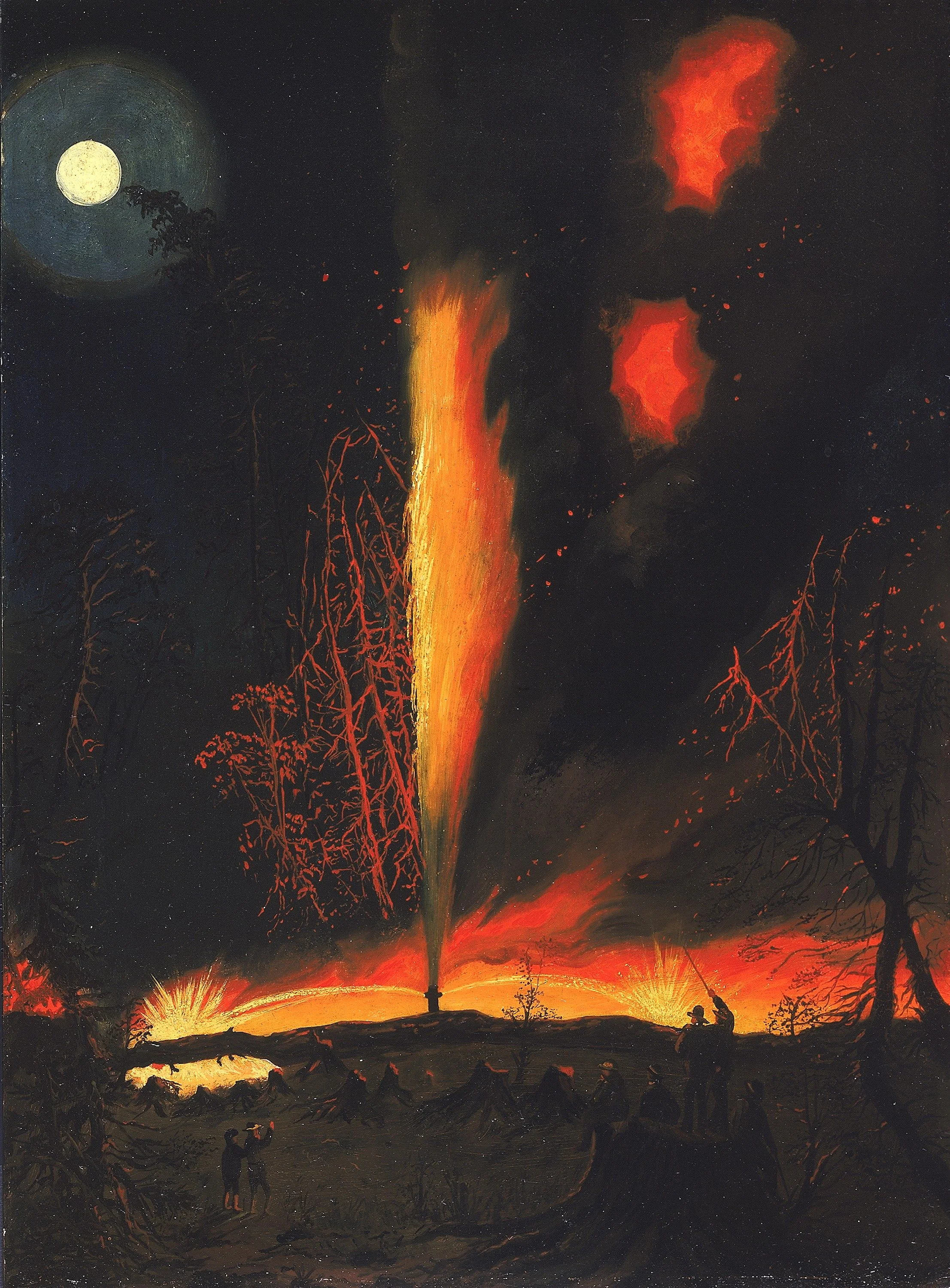
Burning Oil Well at Night, near Rouseville, Pennsylvania by James Hamilton, 1861
Dorothy Eckerberg never remarried, but she did have occasional romantic assignations. It was one of these that produced her illegitimate son, John Harrison Eckerberg, born December 13th, 1942. The identity of John’s father has never been verified, but most historians point towards aviation magnate Edward Rossdale as the most promising candidate.
John was, in many ways, the photo negative reversal of his mother. Though he was raised in a demanding environment by a series of strict tutors, caretakers, and personal trainers - and with the long shadow of his mother never too far off - every account of the boy paints him as a delicate, kind, patient soul. Stories abound of the young man nursing wounded animals back to health and helping the household staff conceal minor errors from the dark queen that ruled over their manor. His relationship with his mother was always a strained one - perhaps there was too much of an empath’s bleeding heart beating in the boy’s chest for Dorothy Eckerberg’s cold-blooded sensibilities. Though she cared for the boy and spared no expense in his upbringing, she was also bitingly critical of him, even going so far as to openly call him a disappointment in various interviews during the last decade of her life.
John matriculated at Yale University in 1961, originally studying economics before transferring to the School of Forestry and Environmental Studies. Needless to say, his mother objected. Shortly after graduating, he started a romantic relationship with Christina Glover, a photographer and environmental activist. Soon, the two were living together in New York’s Soho neighborhood and John was helping Christina plan various protests and demonstrations. Needless to say, his mother objected strenuously. By the time the two married in 1968, John and his mother had a more or less severed relationship.
But the Eckerberg family history is known for nothing if not for strange, sudden reversals. In 1976, Dorothy Eckerberg passed away suddenly from a stroke. While she donated some of her holdings to private collections and the Greek Revival mansion that she had lived in for over forty years to a historical society, she left all her liquid capital, investment holdings, and business assets to her estranged son. It was quite a shock for John and his young wife, who suddenly found themselves among the wealthiest citizens in America. But once the initial jolt had worn off and the extensive funeral proceedings were wrapped up, the two of them realized that they had been left with a fascinating opportunity.
John spent the next few years divesting the Hephaestus Drilling Company out of its holdings in the oil business, arranging for a series of buyouts and restructurings to make sure nothing he owned had its foundation in a practice that he was philosophically opposed to. The intention for the newly reformed Hephaestus Energy Company was to take all the revenue produced by this divestment and use it to create the thing the oil companies would fear the most: a genuine, viable rival in the form of a clean energy provider. Specifically, John fell in love with the then-maverick idea of green hydrogen: a kind of energy produced through hydrolysis of water. If it worked, it would be a form of renewable power that could rival fossil fuels in their production potential at a fraction of their environmental impact.
The only problem was… it didn’t work.
The theory at the base of the idea was scientifically sound, but scaling it up to the point where it could actually generate enough power to take on fossil fuels at their game proved to be more or less impossible. If anything, the ambition was too far ahead of its time: feasible as a concept but impossible to make work with the technologies of the Twentieth Century. Producing a penny’s worth of energy required a dollar’s worth of investment. John Eckerberg was committed, though: he put in more and more time and resources into making green hydrogen a viable business proposition. He hired better and sharper minds to work the problem. He worked with contacts in the government to find new sources of funding, an avenue of attack that led to little more than six wasted years lost to red tape. He rejected multiple investment offers from capital firms he found distasteful and untrustworthy, instead preferring to continue investing his own personal wealth into the company.
Finally, in 1988, the money ran out. Everything that John had inherited from his mother was gone and Hephaestus Energy was officially declared insolvent and stripped for parts. Most analysts placed the blame for its failure squarely at the feet of its inexperienced CEO. John had pursued an idea far past the point where it should have started to show returns, had been over-loyal and over-forgiving to a team that had never pulled their weight, and had been too willing to sacrifice his own assets for a company that should have sunk in half the time it was allowed to limp along. John had been ravaged and visibly aged by the stress of ten years of trying to keep the company afloat while holding onto his quixotic ideals; after Hephaestus was shuttered, he never fully recovered. He passed away nine years later, in 1996.
Which brings us, then, to John Harrison Eckerberg’s only son: Jerome.
Jerome Samuel Eckerberg was born in 1978, the same year that the Hephaestus Drilling Company officially became the Hephaestus Energy Company. He spent the first ten years of his life hearing stories about his grandmother’s great amoral business empire and watching as his father’s dreams for a kinder, more environmental way of doing business slowly turned to ash. He was raised by hippie parents who believed in the promise of sixties, trying and failing to turn generational wealth into a Twenty-First Century company that would truly be ahead of its time, all while being left behind by the realities of the eighties.
It is here that we find one of the great tensions at the heart of Jerome Eckerberg. He is the grandson of one of the richest women in American history and had to take out student loans in order to attended Stanford. He comes from a woman who built an empire out of a tragedy and from a man who created a tragedy out of a fortune. He knows - he has lived, actually - both what the coldest veins and the kindest heart are capable of bringing about.
The story of how, in the course of just ten short years, Eckerberg went from debt-ridden university student to New America tech billionaire is not exactly an uncommon one. He had the vision, the know-how, and the connections to get into the game of online commerce in the early days, as well as a savvy sense of when to hold onto a business asset and when to sell off an investment that had already borne fruits. He was also, it must be said, absolutely brazen when it comes to stealing ideas from allies, competitors, or innocent passer-by, especially during his early days. In one particularly famous incident, Eckerberg quipped that an accuser had better have enough millions to prove that an idea had been stolen. One imagines his grandmother proud, wherever she is.
In many ways, what’s far more interesting than how Jerome Eckerberg acquired his first billion dollars is what he did with it. After all, Eckerberg could have simply focused on his activities as an online retail mogul and probably be even wealthier than he is today. Instead, in 2016, Eckerberg formed Athena Energy, an environmental power company whose purpose and name both harken back to his father’s dream of economically competitive, carbon-neutral power. Except now, from the cutthroat corporate tactics to the deep pools of venture capital investment to the many government contracts that Eckerberg has extracted from four different administrations, (both Democratic and Republican) it can feel like it’s his father’s dream as administered by his grandmother.
It is a tightrope that he has walked for most of his life. On the one hand, the new age idealist with dreams of the underdog David punching out the fierce Goliath. On the other, the great pragmatist, driven by an awareness that sometimes brute force is the only thing that gets it done and that nothing keeps you fighting quite like hatred does. All that remains to be seen now is whether this is a balance that can be maintained all the way across the tightrope… or, if Jerome Eckerberg is destined to ultimately fall, in which direction he’s going to tumble.
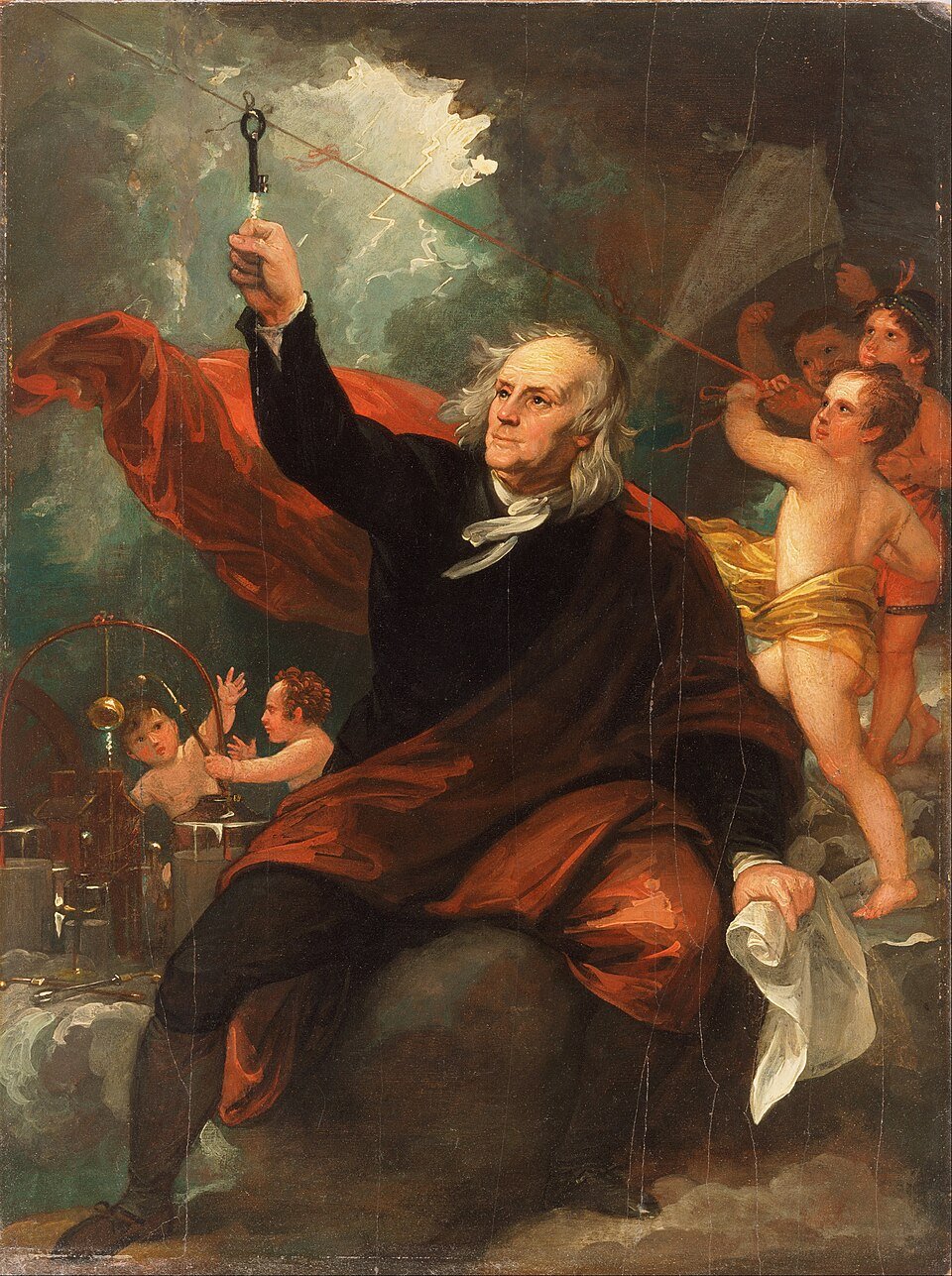
Benjamin Franklin Drawing Electricity from the Sky by Benjamin West
The vault of Harbingers Arcana closes again on April 8, 2026. And the other pieces will be locked… forever? Help us make Season 2 and unlock more Arcana by becoming a member today.