
Arcana 5:
“The Voyage of the Arrow Hawk”
Article by Adam Blackwell on the Final Doomed Journey of Legendary Explorer Desmond Childers
THE VOYAGE OF THE ARROW HAWK
Written by Adam Blackwell
Published in Retroactive History Magazine
March, 2030
In the history of Harbingers archeology, few figures command so much respect, attention, fascination, and… well, the honest term might “unsettled dread” as British Explorer Desmond Childers. Had Childers only had his first interaction with Harbinger history and culture, in which he discovered the ancient column that to this day bears his name, providing academics and linguists a first step on the journey to understanding the Language of the Sun and the Language of the Stars, he would be remembered as a towering figure in the empire’s journey towards rediscovery and reclamation. But he didn’t have just one interaction with them; across five voyages into the Southern reaches of the Indian and Atlantic Oceans, Childers was responsible for the discovery of a dozen tombs, vaults, ruins, and landmarks of what we now know as the Harbinger Empire. In so many ways, he rang the bell that called Harbinger archeology as a discipline into session - he lit the first spark of imagination that led explorers’ societies and anthropologists all over the world to start piecing together the great puzzle of the world’s lost ancient kingdom.
Of course, ever a man of ambition, Desmond Childers would be satisfied with nothing less than the final word on the matter of his own narrative. And so when, in early 1782, he embarked upon his fifth and most ambitious journey yet, taking a crew of ninety-two able men aboard the HMS Arrow Hawk, he thought he was setting off on his greatest adventure of discovery to date. Instead, Childers and his ship ran into disaster, sailing not into a new successful expedition but into the world of the strange and the bizarre. Soon after his return to England, Childers was set to once again embark upon a new voyage, only to disappear without a trace. He seemed to step out of the streets of Portsmouth and right onto the pages of history itself, becoming not just a part of Harbinger history, but perhaps a part of Harbinger myth itself.
He was thirty-three at the time.
The hills of biography and early life have been extensively mined in Childers Country, so let us linger there only for long enough to cover the bare essentials. The son of a Newcastle shipwright, Desmond ran away from home to join the British merchant navy at the age of thirteen. Over the course of his apprenticeship under one Captain Wolfe on board the brig Demesne, Childers proved himself a natural talent in the fields of logistics, arithmetic, trigonometry, astronomy, and cartography. It is also well-known that during his off-hours he proved himself an adept card-player, an inveterate liar, and a daring gambler, to the point that by his second year in the navy few if any of his fellow crewmen were foolish enough to bet against him.
He was promoted to the rank of mate at the age of nineteen, the same year that the Demesne was waylaid by pirates and Captain Wolfe was killed defending his ship. The story of how Childers, armed with nothing more than a hastily drawn map and a broken compass, managed to outsmart, manipulate, and ultimately defeat the pirate crew is the stuff of well-documented legend, so it will suffice to say that when the young man sailed into Portsmouth with not one but two vessels under his de facto command, he was handsomely rewarded and swiftly promoted. He spent three years serving as first mate on the newly refurbished Demesne, and was promoted to captain less than a month before his twenty-fourth birthday.
His first journey into the Southern reaches of the world was in 1773, sponsored by the Royal Society. Tasked with taking a group of British astronomers to Bouvet Island so that they could better observe the passing of Millerand’s Comet, the Demesne instead made landfall at what is now known as Blackrock Isle. It was there that Childers and his crew discovered the pillar, the Rosetta Stone that would begin the process of unlocking the lost tongues of the Harbinger Empire. Let us pause for a moment to appreciate the strange, rhyming beauty of the universe, that the the rebirth of the Language of the Stars would happen before a crew largely made up of astronomers.
Childers’s second great journey was sponsored by la Académie des sciences. The Demesne took a group of mostly French explorers to the recently discovered Desolation Islands, where they uncovered what is now known as the Chamber of Seven Devils. Rediscovering the Harbinger languages and unearthing the first major Harbinger site would have been considered plenty for most people, but Childers was just getting started. Over the course of two more journeys, he’d criss-cross the lower reaches of the Atlantic and Indian Oceans, giving modern archeologists everything from the Restelo Tablets to the Furneaux site in the volcanic slopes of La Rényon.
But it is his fifth and final journey that most interests us today. The infamous journey of the Arrow Hawk. And that is perhaps as good a place as any to begin, the fact that Childers was not sailing his usual ship. The Demesne had taken on damage after being caught in a storm upon her return to England after Childers’s fourth voyage. The accomplished captain could either wait for the repairs to be completed or he could set sail on a different craft.
The HMS Sparrow Hawk set sail on its maiden journey in 1773, led by Captain Jack Turner on an expedition of territorial exploration to the Philippines and their neighboring islands. It never made it to its destination, and the ship was believed to be lost at sea. But it was rediscovered in 1778, cruising several miles off the coast of Algeria, with its hull dulled and scratched, as if it had sailed through an archipelago that had barely left is afloat. Of the crew there was no trace, save for the skeletal remains of the captain, found in the ship’s galley and identified only due to the distinctive pistol that was at its side.
The ship was returned to England, where it was restored to seaworthy state, save for - owing to either a ghoulish bit of miscommunication or a somber acknowledgement of the ship’s history - the spot on its hull where the first two letters of its name were now missing. The rechristened Arrow Hawk was ready to set sail once again. Except… nobody wanted to touch it. Sailors are notoriously a superstitious sort, and none among them found the idea of setting sail on what was quite literally a ghost ship quite as appealing as the harbor master wanted it to be. And so the Arrow Hawk sat on the harbor for nearly three years, its long, dark shadow seeming to grow heavier by the day.
But then Desmond Childers needed a ship - Childers who prided himself in being a man of science in an age of reason and exploration. And Childers who… for some reason that has never been enormously clear, was in quite a rush. The preparations for his fifth voyage happened in record time, with astounding amounts of money changing hands to overcome fearful superstition and make sure the Arrow Hawk was stocked, crewed, and ready to go by no latter than March 1st, 1882. Where exactly these abundant funds came from is a matter of some ongoing speculation. On paper, the expedition was once again funded by the Royal Society, but it would have been uncharacteristically lavish by their standards. On the other hand, it is known that in the weeks leading up to the voyage, Childers had various closed door meetings with Lord North - then the prime minister of Great Britain - at Number 10. Perhaps this particular journey enjoyed the sponsorship of an even more illustrious, more well-funded patron than the Society.
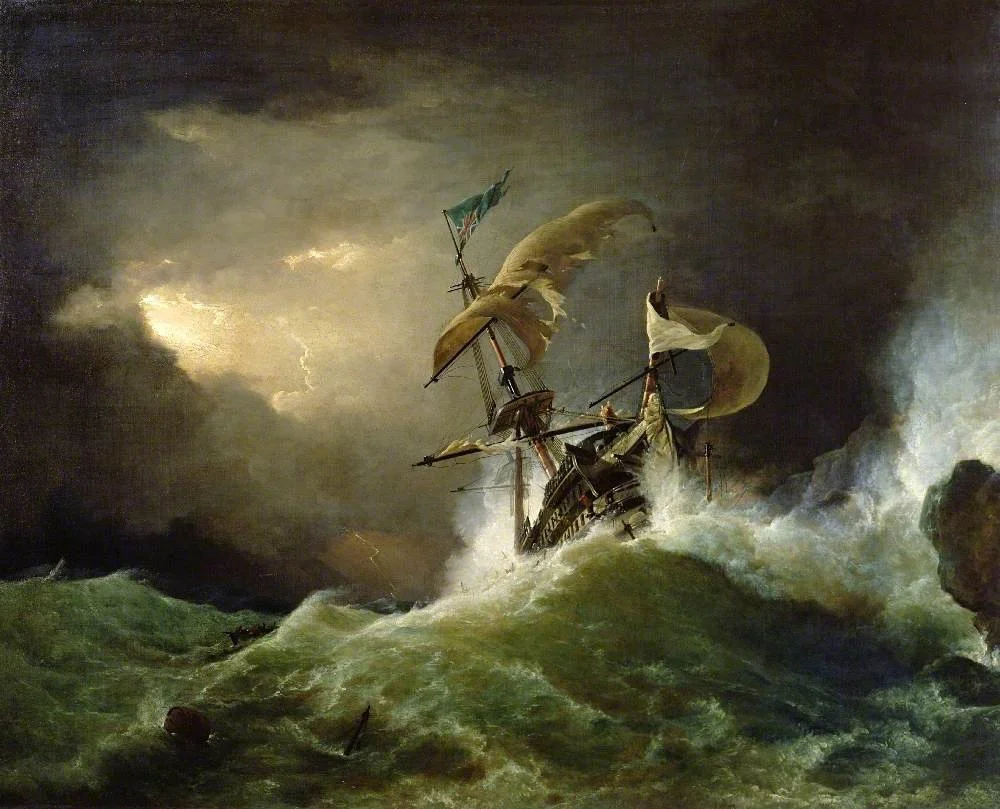
A First Rate Man-of-War Driven Onto a Reef of Rocks, Floundering in a Gale by George Philip Reinagle, 1826
As the Arrow Hawk sets sail from Portsmouth, our narrative is also about to embark into some dark, murky waters. Before we descend into the maelstrom, let’s draw a couple of lines on our metaphorical cartographical charts. Let us begin with what we know to be facts about this expedition.
The Arrow Hawk began its journey from Portsmouth on March 1st, having just barely finished filling its ninety-two man crew roster the previous evening. It sailed West from England, towards the Sargasso Sea in the North Atlantic. This stretch of ocean, often called the “landless sea,” is notorious for its strong winds and the deadly islands of floating seaweed that litter its waters. And if you just went, “How deadly could seaweed be?” the answer is quite. When combined with the sea’s high winds, these accumulations of Sargassum are more than enough to trap a ship. More vessels have been abandoned in the landless sea than have disappeared in the Bermuda Triangle. Writing in Twenty-Thousand Leagues Under the Sea, Jules Verne called this area, “a veritable prairie, a thick carpet of sea-wrack, fucus, and tropical berries, so thick and so compact that the stem of a vessel could hardly tear its way through it.”
Why was Childers and the Arrow Hawk sent into this “perfect prairie?” The official story is that it was an exploratory mission, an expedition to determine the truth behind rumored sightings of uncharted landmasses within these waters. (To this day, Bermuda is the only known island within the Sargasso Sea.) It is, once again, an unusual step in the narrative’s dance, a strangely vague assignment, with little known detail about what would have been valuable, interesting, or strategically important about these purported landmasses.
On May 13th, 1781, a French trading vessel returning from Canada rescued a lifeboat from the waters of the North Atlantic Ocean. On it were four souls, the only survivors from the Arrow Hawk: Captain Desmond Childers, Second Mate Paul Roberts, Ship Doctor Edward Rivers, and Midshipman Jonathan Harlow. All four were nursed back to the health and returned by England by late June.
These, then, are the chunks of icy truth that stick above the water when it comes to iceberg that is the last journey of the Arrow Hawk. The parts that we know to be true. Let us now venture below the surface, into the dark depths of allegation, hearsay, and speculation.
In July of 1782, Captain Childers gave his official account of the journey to officers from the Society for the Insurance of Foreign Vessels, an account which we still have to this day. In it, Childers describes their journey through the waters of the Sargasso Sea, culminating in their sudden and abrupt discovery of a small island. There, the explorers found an ancient stone building, something that they described as a cross between a temple and an ancient observatory. While most of this structure had been worn away by the elements over the years, small bits of surviving wall carvings identified it as having been built by the same mysterious, lost culture that created what was already being called the Childers Column. But the real find was what was inside the structure. A small stone chest or container, about the size of a pistol case. Though the crew was able to ascertain that it was hollow, and that there was something in side of it, they found no way to open it without resorting to measures so extreme that they might or even destroy its contents.
The explorers charted the remainder of the island and returned to the Arrow Hawk, setting off to examine other parts of the Sargasso Sea. But when night fell, they found themselves under attack. Their movement attracted the attention of - as Childers describes it - an enormous whale, one which seemed set upon destroying the ship. For hours on end, the creature would wage war against the Arrow Hawk, ramming into his hall and attempting to trap it in the seaweed islands that dotted the Sargasso Sea. The attacks persisted throughout all of the night, only ceasing when the sun rose. The crew enjoyed smooth - if understandably startled - sailing for all of the day, only to once again find themselves under attack by the same enormous whale when night fell.
Childers’s account describes the extraordinary skill, bravery, and gallantry of his crew as they endured nine nights of siege by this beast, growing more tired and more desperate as the days ticked by and the ship took on more damage. Then, on the tenth night, disaster. A lightning bolt struck the Arrow Hawk, splitting the ship in half. The crew abandoned the craft, with the survivors piling onto four lifeboats, bringing the precious stone chest with them. Over the course of two more nights, the whale picked off three of these boats, killing the majority of Childers’s crew. It was at the start of the next night’s onslaughts that the remaining survivors succumbed to superstition and cast the stone chest into the ocean. At once, the whale was appeased. It ceased its attack and disappeared, never to emerge from the depths. The surviving crew drifted for three more days before they were spotted and saved by the passing French ship.
It’s a remarkable, to not just say outrageously fantastical, story. But perhaps what is most remarkable about it is the fact that when the Society interviewed Roberts, Rivers, and Harlowe, the three men largely corroborated Childers’s account. Even down to minor details about the structure they found on the island, or the methods they attempted to use to open the stone chest. Could this just be the result of the days the men spent adrift in the ocean, with ample time to agree upon the wild fiction they would unleash upon the world? Perhaps - though the uniformity of their story was enough to give the insurance company pause at the time.
What I think is worth pausing at for a moment are the the three areas in which the other survivors’ account does differ from Captain Childers’s. The first of these is the captain’s attitude throughout the journey. Rivers and Harlowe had both sailed with Childers before, and Roberts was a veteran of all his journeys save his second one. In the past, they found Childers a curious, adaptive, thoughtful sailor, one that took each day of a journey as a challenge to be overcome and as an opportunity for adventure and discovery. It’s worth remembering that Childers’s first great discovery came precisely from him deviating from the mission he’d been given. But during this journey to the Sargasso Sea, they found him a grim, obstinate man who drove mercilessly towards his chosen objective - less a wide-eyed explorer and more a taskmaster headed towards a predetermined spot on a map. (Childers insisted that he was doing nothing of the sort - he was taking a general survey of the region, as he’d been instructed to do by his superiors.)
The second point of divergence in the other survivors’ account comes with the point of the stone chest. According to Roberts, Rivers, and Harlowe, Childers quite emphatically did not want to throw it overboard. He was adamant that it had to be returned to England no matter the cost and insisted that they continue to fight the ocean beast to the bitter end. The three men had to physically overpower him and threaten to shoot him before they were able to rid themselves of their find.
And the third point of divergence? Captain Childers is the only one to describe the creature as a whale. The other three never used that word, and insisted that though they couldn’t identify what sort of creature it was, it was amply obvious to all of them that it was not a whale. Among other issues there was the fact that - whatever this being was - it was at least a hundred and thirty feet long. (The largest blue whales top out around a hundred feet even, just for the record.) All three men were in absolute agreement: whatever had destroyed their ship was not a whale.
It had been a monster.
How much of this astounding story is true? And if parts or all of it are mendacities, why would these men lie so outlandishly but with such fierce commitment? Unfortunately, we’ll likely never know. None of the four ever recanted their original story or offered up an alternative, and none of lived long enough to offer a different perspective on this disastrous adventure. Roberts died in a duel in 1884. Rivers passed away of a sudden illness in 1889. Harlowe fell off a horse and broke his neck in 1891. Captain Desmond Childers famously did his best to put the whole affair behind him, immediately starting preparations a the new journey of adventure and exploration on board his beloved, now fully-repaired Demesne. He was scheduled to set sail on December 26th, 1782. On Christmas Day, he stepped outside of the Portsmouth house he shared with his wife and daughters, claiming to be going out for some air. It was the last time anyone laid eyes on him. He disappeared without a trace, and to this day no body or credible explanation of what happened to him has ever been found.
It is this infuriating and alluring combination of tragedy, outlandishness, and mystery that has made the last journey of the Arrow Hawk such an object of fascination for so many people. It has been dramatized in two separate films, one in 1934 and one in 1961, and provided the inspiration for countless “fantasy in the high seas” novels. (1992’s Under the Blood Red Tide is a personal swashbuckling guilty favorite - check it out for all your schlocky needs.) Likewise, the events of this journey have provided ample grounds for conspiracy theorists of all sorts. Fantasists have long speculated that Childers was sent to the Sargasso Sea on a secret mission, an assignment of retrieval more than one of exploration. But how could the Prime Minister have known about this mysterious island and its tantalizing stone chest? As an entirely unrelated fantasy film once put it: “None now live who remember it.”
The 21st Century and its technologies have brought little by way of definitive new light into any of this. Satellite imaging has now thoroughly examined every inch of the Sargasso Sea, and has found nothing remotely fitting Childers’s descriptions on around the approximate location he claimed to have found the island on. (Neither, for that matter, have countless amateur expeditions by Childers Truthers over the preceding two and a half centuries.) And needless to say, no mysterious, ancient stone chest or enormous underwater leviathan have ever been spotted, either in this particular area or anywhere else in the Atlantic Ocean.
Still, ever since your humble author’s discovery in late 2025 of Shral Ta Keren in the depths of An-Serith, much of what has long been considered Harbinger fable or fantastical wishful thinking has had to be re-examined through the lens of… well, of magic being a real, active force in the world. In a world that contains the wonders that have come from the Rings of Movement, of Sympathy, and most recently of the Skies, the outrageous story of the final journey of the Arrow Hawk seems far less outrageous. Could Childers’s stone chest contained a Harbinger ring of magic, perhaps? And if it did, what powers contained within merited such a terrifying guardian?
No one knows the answers to these questions, I suppose, save perhaps for the ocean itself.
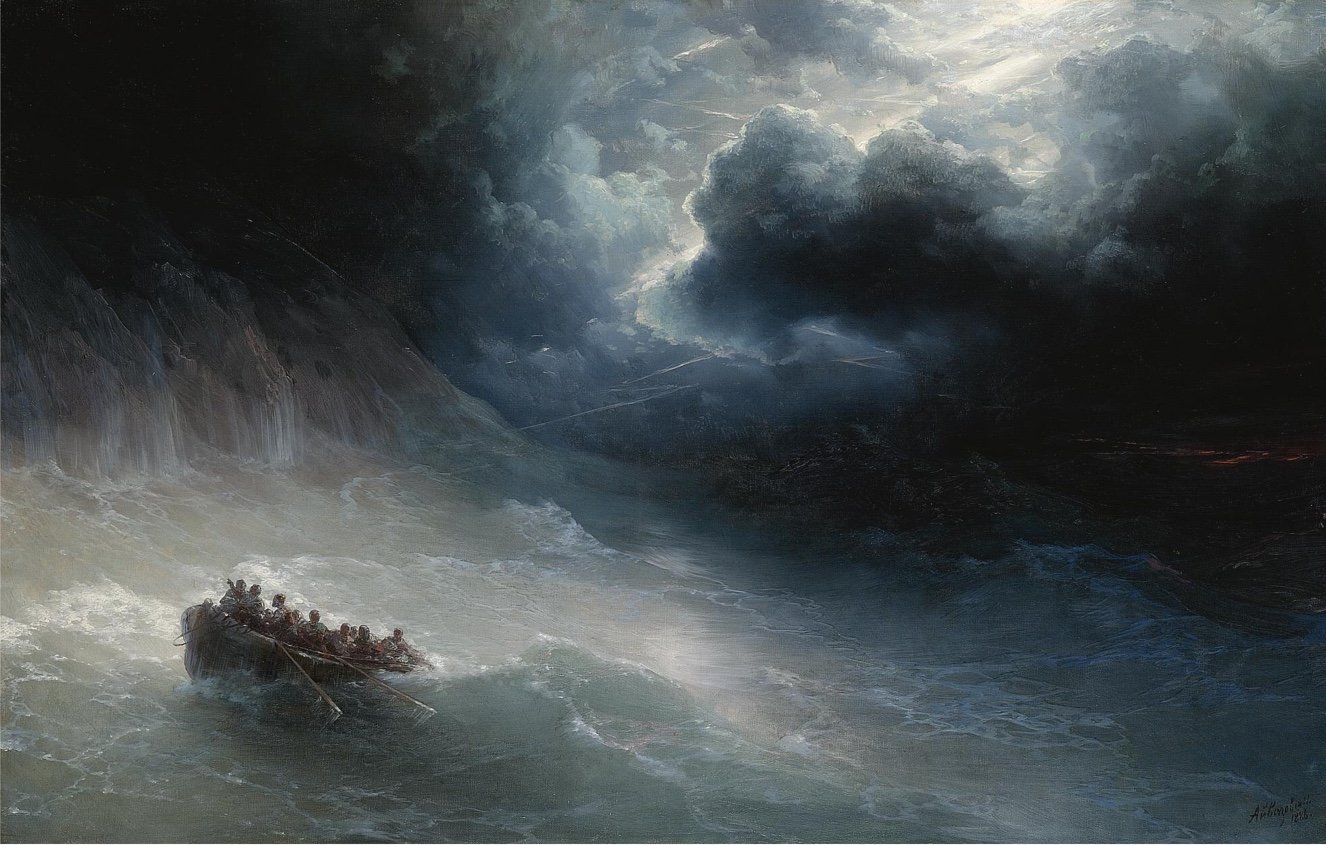
The Wrath Of The Seas by Ivan Aivazovsky, 1886