

ARCANA 7:
"The Storm Before the World"
An Exploration of the Harbinger Creation Myth by Professor Genevieve Summers
THE STORM BEFORE THE WORLD
Translated by Genevieve Summers
Published in History & Society Magazine
November, 2026
In the beginning there was the great, endless grey of all that would be.
The orderless reality storm - a place where all thoughts, ideas, and realities bled into each other. Every creature was man and beast. Every moment was both yesterday and tomorrow. Every idea was both true and false. And every inch of the world was both alive and dead at once.
To the great chaotic chasm of all that was came Varen and Nyria. He who is called the Singular and She who is known as the Many-Faced. He came from far in the East, the realm of light. She came from the West, from the labyrinthine depths. Though they knew not of each others’ existence, they were drawn together by the threads of destiny. In the eye of the great storm that was the world, mind met mind and hand met hand and breath met breath.
And in that moment, the journey of eternity took its first, shuddering step.
The Singular and the Many-Faced were equal and opposite, matched in skill but not in nature. They moved on each other and around each other, finding in the dance of their reflection the notes of the secret music that dictated the movements of the storm that was the world.
And it was through and around each other that they found the way to change this song, and in changing the tune discovered how to tame the tempest. And as the winds were stilled and the churning quelled by their dance, the pieces of the all-thing grew distinct and came into focus.
So was the great game of shaping and naming played, with Varen and Nyria taking turns to pull fragments of the gale and staking ownership over them. Where he laid claim to the sky, she was mistress of the sea. Where he shaped the wind, she named the rain. The bear, the fox, and the seal belonged to him, while the wolf, the owl, and the spider were her creatures. He was rock-breaker, and valley-carver, and horizon-setter; she was fire-starter, and shadow-weaver, and fate-spinner.
On and on the new music of the world rang out, until all had been pulled from the storm before the world and given form and purpose. All, save one thing: she who would be the first of the humans. And as both Varen and Nyria reached out to her as one, their hands met once again through the flesh of this first of many. And in that moment, both laid claim to the steps that would take human-kind through the world.
And so it was that all things were made singular and unique save for one. Because humans, alone in the firmament, would have both of the Singular and the Many-Faceted in them, and thus be a creature of multitude and contradiction. Both hunter and hunted. Both maker and destroyer. Both fire and water. And both alive - and thus destined for death - but also uniquely aware of the shadow of the void that awaited them and capable of leaving a shadow of themselves behind as well.
And it is in the multifaceted nature, this legacy of the storm that was the world, that humanity would find both triumph and tragedy.
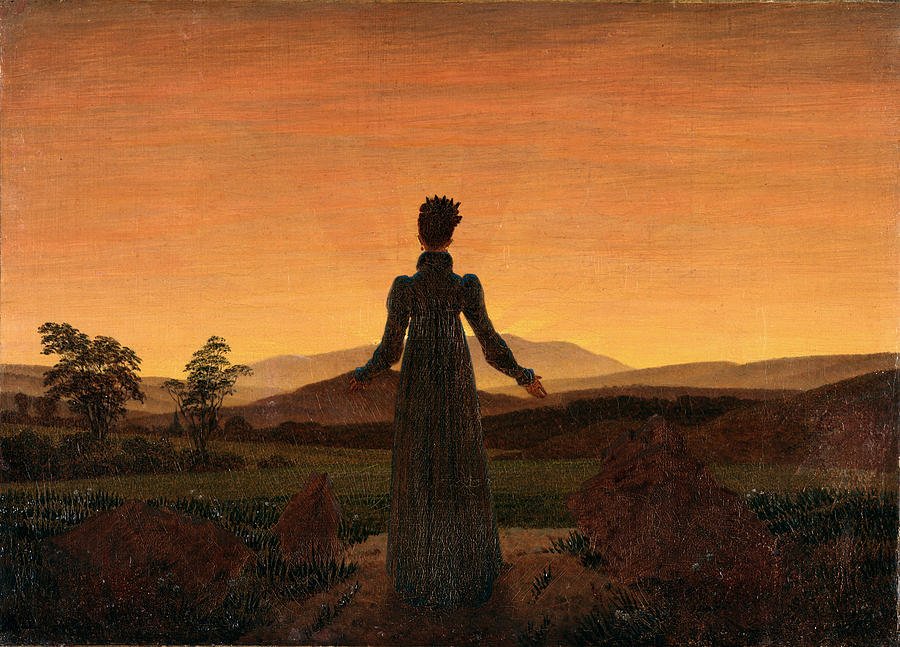
Woman Before the Rising Sun by Caspar David Friedrich, 1818-1820
Commentary
Published in History & Society Magazine
In 1883, German archeologist Emil Falk carried out an excavation in what is now known as the Leeward Islands in French Polynesia. What began as an initially disappointing expedition eventually struck gold, uncovering the remains of a millennia-old Harbinger complex which had been buried - and thus largely preserved, from a certain point of view - by a volcanic eruption. In terms of material for study, the Falk site was the greatest find since the heyday of the Childers expeditions. It would not be equalled until the discovery of An-Serith in 1998.
Falk passed away in early 1883 from a sudden fever - probably bought on by an infected bite from the abundant wildlife on the island - but his work was carried on by his assistant, Jonas Becker. It was, ultimately, him who in 1884 delivered back to Naturhistorische Gesellschaft Nürnberg what we now call the Falk-Becker tablet. On this rock we can find what remains to this day the most complete and detailed version of Harbinger society’s creation myth that has ever been found.
In the nearly hundred and fifty years since its discovery, the Falk-Becker tablet has been an object of endless study, fascination, and fetishization, not to mention the origin of more than a few bitter academic feuds. Compare and contrast the first, clumsy translations of its contents with the one found above and you will see the by-products of fifteen decades of evolution in our understanding of the Language of the Sun. Sections of it, which have long seemed like the ramblings of a madman somehow wandered into the telling of a myth, have only recently come into syntactic focus.
I say all of the above, in part at least, to remind us not to fall into the same traps as past students of archeology. Harbinger linguistics is a moving target, and the Falk-Becker tablet remains a living document. Write any conclusions about its contents down with a pencil, have an eraser handy, and get ready for translators a hundred and fifty years from now to find what we thought it said either adorably quaint or dreadfully shortsighted.
With that sizable grain of salt now firmly on our plate, let’s move onto the fun part and draw some conclusions. Because few primary sources can offer up more insights into Harbinger cultural outlook than this myth. Any story about a beginning is also, inevitably, a story about an ending, and the life that the teller believed was worth living on the path from A to B.
The Harbinger fascination with mirrors and dualities is front and center in this narrative - the words “Erio Aldro Syrandel” might as well be its official sponsor. Creator figures Varen and Nyria are the first of many Harbinger mythological opposite sets - him from the East, her from the West, one masculine, one feminine, etc. The idea of one of them being “singular” and one of them being “many-faced” was a slippery one for many archeologists to wrap their minds around, until they remembered the namesakes for the Harbingers’ complimentary languages; Varen is almost certainly an expression of the sun, while Nyria is the same for the stars. The separate but equal forces which dominated the visible world, each for roughly half the time in the world, exerting the heavy, gravitational force that defined creation.
Note all the things which this narrative does not make its dominant figures into, though. Varen and Nyria are not gods, being depicted as neither all-powerful nor inherently divine. (Though they are certainly Other, originating in a sort of oddly metaphysical expression of “East” and “West” - again, probably an ancient way of grappling with astronomy and the notion of outer space.) There is no indication that one of them is “good” while the other is “evil,” there is no benevolent caretaker and malevolent perverter. Some of those notions would emerge in other places in Harbinger mythology (especially around the figures of the seven angels and seven devils) but it’s starkly absent in this foundational text.
Also missing? Any sense of Varen and Nyria being inherently greater than humanity. They are doers of great deeds, certainly, but there is no hint that they are beings of a fundamentally different sort than their “creation." They are not inherently divine beings who create ax nihilo, they are orderers who work off of the prime materials that predated them. What gave them the ability to shape the world was not some divine spark or fundamental quiddity, it was discovering “the secret music that moved the storm.” There is no mention of this music being above the ken of mere mortals, no firm, finger-wagging warning that pursuing this knowledge would be an act of blasphemy. Many creation myths demarcate a clear line between the business of the creators and the business of the created, but this fence is conspicuous in its absence from the Harbinger creation myth. Appropriate enough, I suppose, for the society that would come to find magic words that would let them subvert the laws of thermodynamics.
As with all Harbinger primary sources, linguistic quirks and tough translation choices abound in every iteration of this myth. To name but a few of the most divisive issues: Varen and Nyria are said to have stilled the winds of the storm before the world through their “dance,” but corenta could just as easily mean “fight” or “duel,” depending on the context. This translation refers to humans in a nod towards clarity, but a more straightforward expression of the term on the tablet - kirenda - would be “traveler” or “voyager.” The words that lead us to “maker and destroyer” could also be translated as “guardian and challenger.” There’s even some apparent contradictions in the narrative: the “threads of destiny” brought the creator figures together, but then Nyria is said to be the “fate-spinner.” Is this an ancient continuity error or a deliberate commentary on the cyclical, reflective nature of reality? Fate makes the world, only for the world to make fate, only for fate to make the world, and so on. And on. And on.
Which of these notes ought to be emphasized in the symphony of the Falk-Becker tablet is a matter, ultimately, of personal judgment on the part of the individual translator. Apologies to those looking for definitive answers and fans of closed cases - we’ll likely be arguing about these sorts of details and interpretational nuances for hundreds of years to come. Perhaps the Harbingers would have liked it that way.
Finally, some words ought to be said about the myth’s depiction of humans, the voyagers through the journey of eternity. Lest our species-wide ego gets too high and mighty by our ability to pursue the music that shapes creation, note the unusual way we are framed by the narrative. Not as chosen peoples, not as appointed masters of creation made in a deity’s image, but - ultimately - as flawed creations. The product of a magicians’ squabble rather than as their ultimately triumph. Our multivalent nature and evolved perspective was neither gift nor charge, but a simple legacy of the chaotic beginnings of the world, imperfectly purged from our nature in the final moments of the ordering. We have to reach high, I suppose, for we are starting quite low indeed.
Of note too is the way in which this myth economically lays out the Harbinger idea of death and spirituality, at least as these ideas apply to humans. Other sources, especially those in An-Serith, have considerably expanded our knowledge of their beliefs in these matters, but the heart of it is contained right here. In a single sentence, the Falk-Becker tablet lays out their concert of Argen - roughly “life” or “vitality,” our lifetime or the time we each get on earth - Suikan - “Void,” the shadowed place our spirits go to after our death - and Miran - best approximation there would be “impression,” a sort of… psychic imprint which our lives and actions left upon the world, which lingered long after we’d gone on into the void.
Sitting here in 2029, writing about modern translations of their writing from thousands of years ago, it’s hard to not think they might have been onto something with that last bit.
- Genevieve Summers
November 1st, 2029
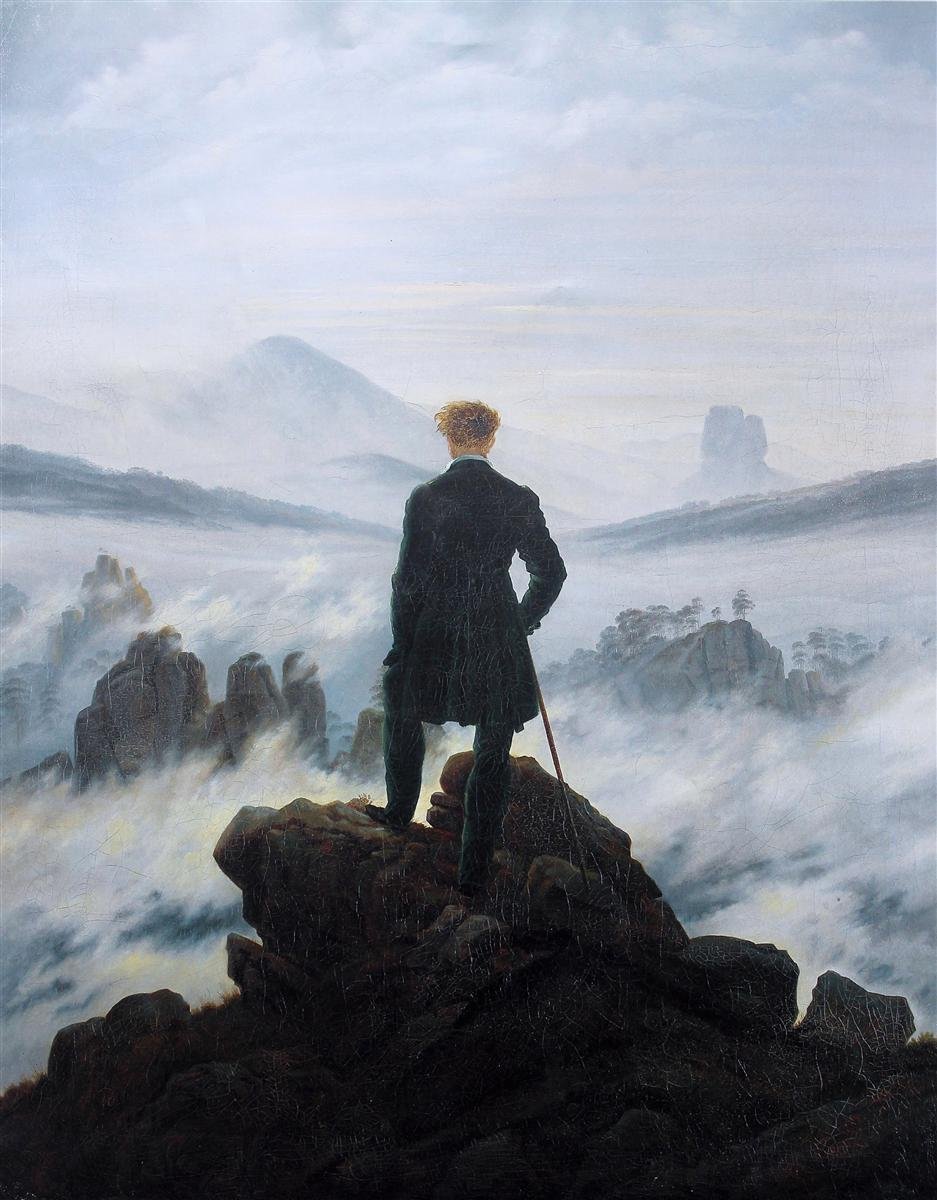
The Wanderer Above the Sea of Fog by Caspar David Friedrich, 1818